Friday, February 27, 2015

R. I. P. Lucille

I lost one of my hens today. This morning I went out to the coop to open up the box, and found Lucille, my pretty barred Plymouth Rock, lying by the door. She had either fallen or jumped down from the roost during the night, and the cold must have been too much for her (the temperature was -4 at 6:30 a.m.).

I don't know what else could have happened. She seemed like the most robust hen in the flock, always pushing her way ahead of the other hens for treats and attention. I didn't notice anything amiss with her yesterday--she definitely seemed fine last night when I shut them into their box for the night. If I worried about anyone during these cold, cold days, it was Nettie, my skinny little Rhode Island Red, who has already experienced two close brushes with death, from a hawk and a fox.

I'm just so sad today. I keep thinking I should have put a light out there to warm them, or insulated their box, or checked on them more often, or . . . something. But then again, chickens are mortal creatures, and just like us, they sometimes go too soon.

Lucille and Fanny, in warmer times.


Saturday, January 10, 2015

A Break in the Weather

What a difference a day makes. Today it's a sunny 23 degrees outside, and the chickens seem pretty happy about the change.

I mixed up some oatmeal for them, which was a big hit.


That yellow thing in the picture is a little container for scratch. The chickens kick it around and release a little bit at a time--kind of like a chicken Kong.

I'd read somewhere that if you put Vaseline on the chickens' combs and wattles it protects them from frostbite, and since the temperatures are supposed to plunge again this week, I thought I'd give it a try. Rob volunteered to help, and it was definitely a two-person job--I caught and held the hens while Rob applied the grease.

The hens tried to wipe off the Vaseline in the straw, and the results were kind of comical.


After the spa treatment, I put a big pile of straw in the annex for them, and they were delighted. They immediately set to excavating.


Thanks to our friend, Cara, for the generous donation of straw!

Friday, January 9, 2015

Cold Chicken

This week has been a cold one. Really, really cold: lows of -3 and -10 the past two nights (not counting the wind chill). And it seems that everyone asks me, "How are you keeping your chickens warm in this cold?"

I don't know that I'm keeping them warm--the only way to be sure of that would be to bring them into the house with me, and I know I won't be doing that. I also won't be putting a heat lamp in their coop. Most chicken folk I know agree that putting a heat lamp in a coop with straw and other combustible materials is not only unnecessary but dangerous; just last year, in fact, a coop in our neighboring town of Urbana burned down because of a heat lamp.

I try to remind myself that songbirds with a lot less body mass are out there in the cold all day and night, and we don't often think about how they stay warm. Last year, when I was ordering my chicks, I was careful to choose breeds that were especially suited for cold-weather life--"cold-hardy," as they say in the poultry business. And when we built our coop, we made sure it had an elevated, enclosed box with good ventilation. Hens can get frostbite when too much moisture builds up in their coops, not just from the cold alone.

But even in this extreme cold, the girls seem to be doing just fine. Every morning I go out to their coop and open the pop door to their box, and they trundle down their little ramp to hang out in the run and soak up the morning rays. They generally stay in the run until about 4:30, when they climb up the ramp to the box and hop up to the roost--all except Capitola, who for some reason always waits for me to come home from work and lift her up onto the roost. Even on the coldest days we're still getting about 3 eggs, although Wednesday's eggs actually froze solid and cracked their shells before we could bring them in.


But sure, I still worry about the hens. So I've been putting extra bedding in the box and extra straw in the run for a little added insulation. And I'm giving them extra rations and a couple handfuls of scratch every day to make sure they're getting plenty of calories to stay warm. And to make sure they always have access to water, I invested in a metal plate heater for their galvanized waterer. That will keep us from having to thaw their water during the day.

But ultimately, I'm trusting my girls. Chickens are tough enough to survive even bitter cold like this. As my friend Debbie points out, they go around wearing little down jackets, after all. And if they're really cold, I know they can always retreat to their roost and huddle together.


Wednesday, December 31, 2014

How Do YOU Eat Chicken?


When my kids were little, they loved to listen to Wolf Story, a wonderful children's book written in 1947 by William McCleery.

The book centers on the story that a man tells his young son about the misadventures of a wolf who steals a chicken from a clever little boy named Jimmy Tractorwheel. Waldo the wolf soon finds himself outsmarted not only by young Jimmy but by the chicken, Rainbow, who is definitely not the "poor little twerp of a hen" that Waldo thinks she is.

In one scene that my kids especially loved, Rainbow the hen is shocked when she learns that Waldo plans to eat her without the benefit of a knife or fork:

"`I hope you weren't planning to eat me with your fingers,' said the hen.
"`How do you eat chicken?' cried the wolf.
"`I,' said the hen, `do not eat chicken.'"

I don't eat chicken myself anymore. But lots of people and critters do, and this year we've had a couple of narrow scrapes as our chickens almost became prey.

So here are two stories from 2014: one a hawk story, and the other a fox story. (No wolf story of our own yet, thank heavens.)

1. The Hawk

My son called me at work the Friday after Labor Day. School had dismissed early because of the heat, and he had let the chickens out to roam the backyard. I'd encouraged him to do this, thinking that as long as someone was home the chickens should be safe in our fenced backyard.

Will sounded worried. He told me that he couldn't find Lucille, our Barred Rock, and couldn't get the other hens out of the bushes and back into the coop. I thought the chickens were just being recalcitrant, so told him I was headed home soon and would just look for them when I got there.

When I arrived home, I headed out to the backyard, and found this:


And near the garden, I found this:


Now I was worried. Something had clearly attacked the hens, and I feared the worst as I looked around the backyard.  I soon found four of them--everyone but Lucille--huddled together under a bush, clearly a little traumatized. Both Fanny and Nettie, our Rhode Island Red, had lost feathers on their backs, but no one was bleeding or visibly injured. I shooed them back into the coop, shut the door, and called for Lucille. A minute later, I heard her warble near the fenceline--and saw she was hiding out in our neighbor's bushes. I'm guessing that when the excitement began, she slipped through the opening into their yard, where all was quiet.

I brought her home and shut all five hens in the coop. An hour later, I looked out the kitchen window and there was a big red-tailed hawk sitting on the coop roof, clearly wondering where dinner had gone.

2. The Fox

We had heard from several of our neighbors that we had a fox in our neighborhood; one told us that he had seen the fox early one morning while walking his dog on the next block. A few weeks later, while feeding the chickens around 7:00 a.m., I spotted the fox myself, as he stood stock-still outside our metal picket fence while the hens stood just as still inside the fence watching him.

At the time, I congratulated myself on our "chicken-proofed" fence. Earlier this summer, my daughter and husband had attached hardware cloth to the bottom of the fence to keep the chickens from slipping out, and foolishly, I thought this would be enough to keep other critters out.

Then, one morning in late November, I let the chickens out of their coop while refilling their food and water. I was in the habit of letting them out to forage in the fenced backyard while I ate breakfast and got ready for work, thinking that surely no big predators would attack them in their own yard in broad daylight. That morning, my husband and I were both in the kitchen when he happened to look out the window just as the fox zipped across the backyard making a bee-line for the hens. He dashed out the door yelling "Fox!" I looked out and saw the fox pounce and feathers flying and ran outside myself, just as the fox wheeled away and leaped over the fence.

Poor Nettie! Once again she had been the victim. Although she was missing a clump of feathers off her back, she was otherwise just fine. I herded the hens back into their box, and vowed then not to let them out again unless I was out there with them. There are just too many critters out there who like to eat chicken.

Here's hoping for a predator-proof 2015!

Thursday, September 18, 2014

Eggciting Developments

Park Avenue Poultry is now in production!

This week--finally--we have eggs. I found the first one last Thursday, when I got home from work and went out to check on the girls as I usually do. Capitola, my friendly Buckeye, hopped down from the box, which struck me as odd, since the hens don't usually go up to their box until dusk, when they're ready to roost for the night.

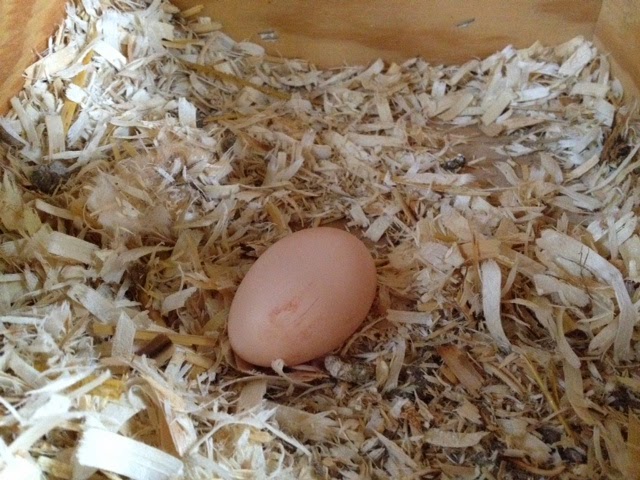
I looked in the nest box and sure enough, there was an egg. Since it was no longer warm, I didn't think Capitola had just laid it, nor was I sure she was actually the hen who laid it.  Nevertheless, I was pretty excited, so I had to take a photo:


On Saturday, I found a second egg that looked just like the first. I read somewhere that experienced chicken owners can often tell which hen laid which egg by the color and shape of the egg, and I remember thinking at the time that all eggs looked pretty much the same to me. But those first two eggs actually looked very similar--both were distinctively oblong with a fairly pointy end.

Then, on Monday, I saw Capitola step out of the nest box, and reached around her to retrieve a third egg, just like the other two. And it was still warm, which told me Capitola was probably the layer of all three.

Tuesday, when I went out to feed the girls after my morning run, there was another egg, and this one looked different--a little shorter and more rounded than the first three. So someone else is evidently getting in on the act!

In celebration, Rob and I had scrambled eggs for breakfast.


Saturday, August 16, 2014

Regulating Chickens

So this week another city in Illinois--Rockford, about 85 miles northwest of Chicago--is considering allowing people to keep hens in their backyard. One of the alderman there was quoted as saying, "There seems to be quite a bit of momentum from the pro-chicken group." Good for them! I hope they're successful.

It's still hard for me to understand why people would be opposed to their neighbors keeping a few backyard hens. Certainly there's a lot of misinformation about chickens--people think they're loud, they're smelly, they cause disease, etc.

When Champaign revised its ordinance last year to make it possible for folks to keep backyard hens, the City Council did so with a few restrictions:
  • A license must be issued to legally raise hens.
  • No roosters allowed.
  • Up to 6 hens allowed.
  • Coops may only be located in the back yard.
  • Only residents of single family and two-family homes are eligible for a coop license.
  • The coop must have a minimum of four square feet per hen.  The run must have a minimum of eight square feet per hen and be covered on all sides, including the top.
  • Residents who do not comply with Sec. 7-19 – Hens and all applicable sections of the Champaign Municipal Code will be subject to enforcement action.

Although I would do whatever was needed to keep chickens, I had mixed feelings about this kind of regulation. Early last year, I had talked with a number of folks in Urbana who kept chickens, as well as people who lived near chickens, and no one seemed to think there were any serious problems that needed policing.

I wouldn't want chickens if I didn't think I could keep them and still be a good neighbor. In fact, even before I visited the City Council, I'd already decided I wasn't interested in keeping roosters, and I didn't plan to let my chickens free range, since I didn't want them to be carried off by hawks or other predators. But it still makes me wonder why people are so nervous about their neighbors keeping a few chickens in the backyard.

There was a time, after all, when people didn't see chickens as incompatible with city life. During World War I, people were encouraged to keep chickens in their backyard as part of their patriotic duty, and the victory gardens of World War II also included chickens. So what changed? Why did so many communities outlaw chicken-keeping--even agricultural communities like Champaign?

An article I ran across in the Journal of Planning History shows how the regulation of animals in American cities was a major concern for public authorities in the eighteenth and nineteenth centuries, and ultimately gave rise to the establishment of planning as a profession. (See Brinkley, Catherine, and Domenic Vitiello. "From Farm to Nuisance: Animal Agriculture and the Rise of Planning Regulation." Journal of Planning History 13.2 (2014): 113-135; available here: http://jph.sagepub.com/content/13/2/113.full.pdf+html

The authors outline several major waves of city animal ordinances, from 18th century restrictions on cattle and swine running loose in US cities to 19th century bans on urban piggeries (how I love that term!) and dairies due to public health concerns, and ultimately, to the mid-20th century removal of farm animals from most cities through city zoning laws.  In an optimistic coda, the authors note that if planners were responsible for the removal of animal agriculture from American cities, they could, with their increasing focus on biodiversity and integrated land uses, also be the ones responsible for restoring animals to urban settings.

So maybe all this chicken regulation is just the system attempting to right itself. Maybe that's what it will take to convince city-dwellers that a few chickens in their neighbor's yard are not going to cause a public health crisis, lower property values, or pit neighbor against neighbor. Maybe someday the majority of people will think it's reasonable, even desirable, to keep your own chickens rather than buy eggs and meat from factory farms. And maybe city planners (including the ones in Rockford!) will be helping to bring that change about.

Sunday, August 3, 2014

Pullets!

Back in early June (!), I promised to write more about the chickens. This week the girls, as they are affectionately called around here, are 17 weeks old.

When last I wrote about them, they were still chicks, but as you can see from the photo of Capitola below, they are now pullets, in poultry-keeper parlance. We've had no eggs yet, but I'm hopeful that they'll start laying sometime in the next month.


While we're still waiting for that first egg, the flock has experienced a fair number of "firsts" already this summer. Soon after moving into their new coop in early June, they had their first party--a "coop opening" for our friends and neighbors to get a chance to see them and to help us celebrate the return of chickens to Champaign. Many of our neighbors already knew of my interest in keeping chickens--some had even expressed their support to the City Council--and I wanted to be sure to thank them and give them a chance to see the hens for themselves. We also invited members of the City Council, and Lacey Rains Lowe from the City's planning office. Also in attendance were many of our long-suffering friends, who patiently tolerated a lot of talk about chickens this past year.


It was lots of fun--we had cake and lemonade, and the girls got coverage on the evening news, as well as a photo in the newspaper. My friend Lisa even devoted an episode of her Backyard Industry to the occasion.

In late June, we went to Colorado for a family vacation, so the girls also had their first chicken-sitter. It was a first for our friend Sierra too, who had never taken care of chickens before, but it worked out fine for everyone.

This summer the hens have tasted lots of new foods for the first time as well: blueberries, apple bits, tomatoes, cucumber, and kale have all been favorites. Nothing comes close to their love of mealworms, however, or any other live prey. The other day I turned over one of our flagstones in the back yard, and found an ant colony with lots of wriggling larvae. The chickens ate them so quickly I didn't even have a chance to get a photo, so here's one of me giving them some tomato from earlier today.


If you listened to the Backyard Industry piece, you'll know that I also worked with some other chicken-folk here in the twin cities of Champaign and Urbana to organize another first, our very own C-U coop tour. More on that in my next post!